Introduction
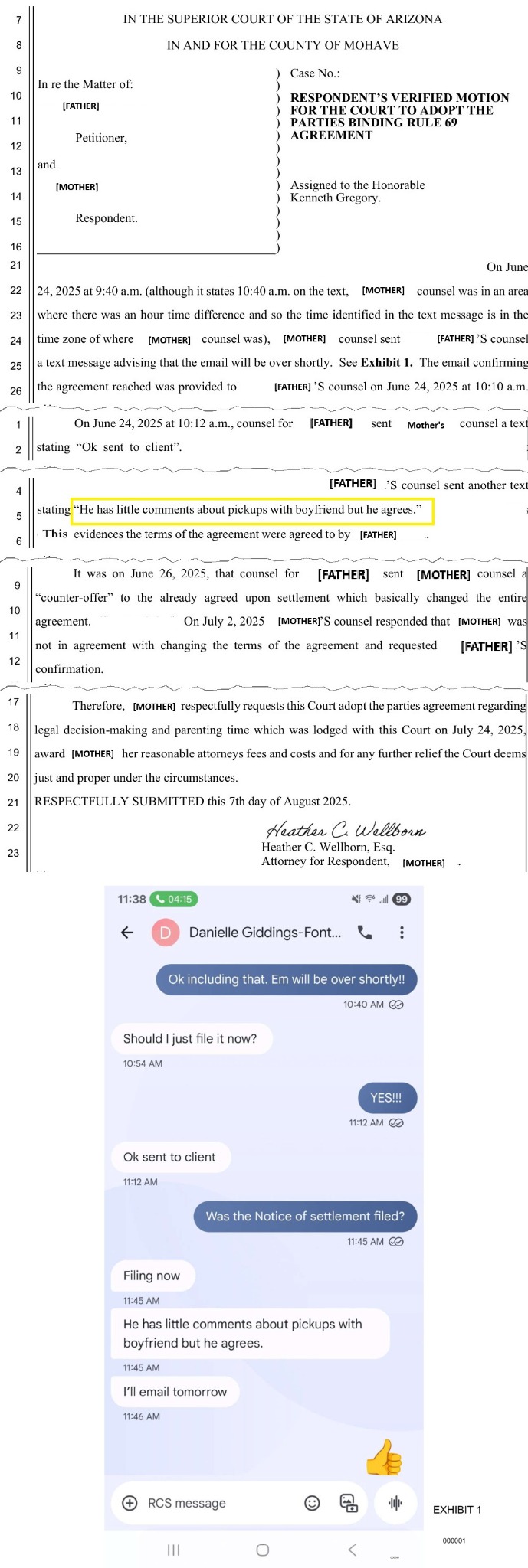
On June 24, 2025, my former attorney, Danielle Giddings Fontenot of Fontenot Law PLLC, sent a text message to opposing counsel stating:
I did not know that text existed until it was filed in court as evidence that I had agreed to a parenting plan.
This website presents the documents, timeline, and rulings surrounding that dispute so readers can review the record and draw their own conclusions.
Although this case concerns one custody dispute, the legal issues discussed here arise under Arizona family law and are not unique to Mohave County.
The attorneys, judges, and proceedings described on this website were located in Mohave County, Arizona. As a result, the events documented here may be of particular interest to parents involved in family law matters in Bullhead City, Fort Mohave, Golden Valley, Kingman, Lake Havasu City, and surrounding communities.
The questions raised concern Arizona Rule 69 agreements, parenting plans, attorney authority, and family-court procedure—issues that can arise anywhere in Arizona.
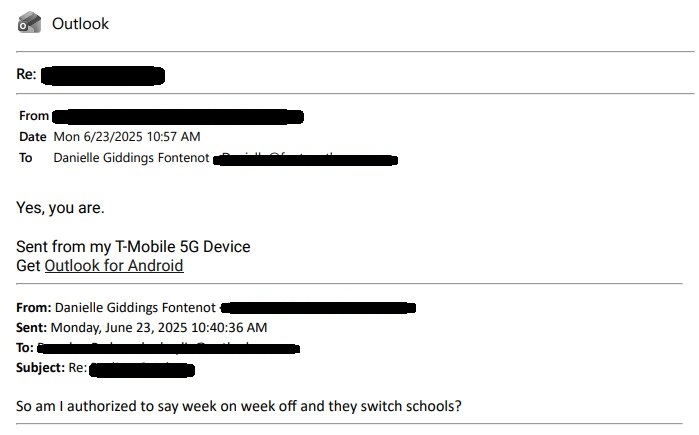
Chapter 1: The Authorization Email
After months of unsuccessful settlement efforts, Father authorized discussion of two issues: a week-on/week-off parenting schedule and whether the children would switch schools.
Chapter 2: The Proposal
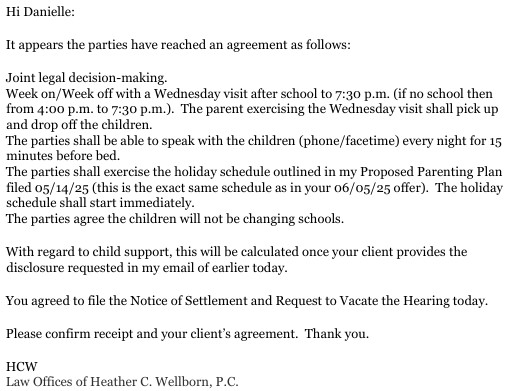
The following morning, Mother's counsel sent a written proposal beginning with the statement: “It appears the parties have reached an agreement as follows.”
The proposal addressed the schedule and school issues, but also included numerous additional terms regarding holidays, phone calls, exchanges, legal decision-making, and other parenting provisions.
Chapter 3: The Objections
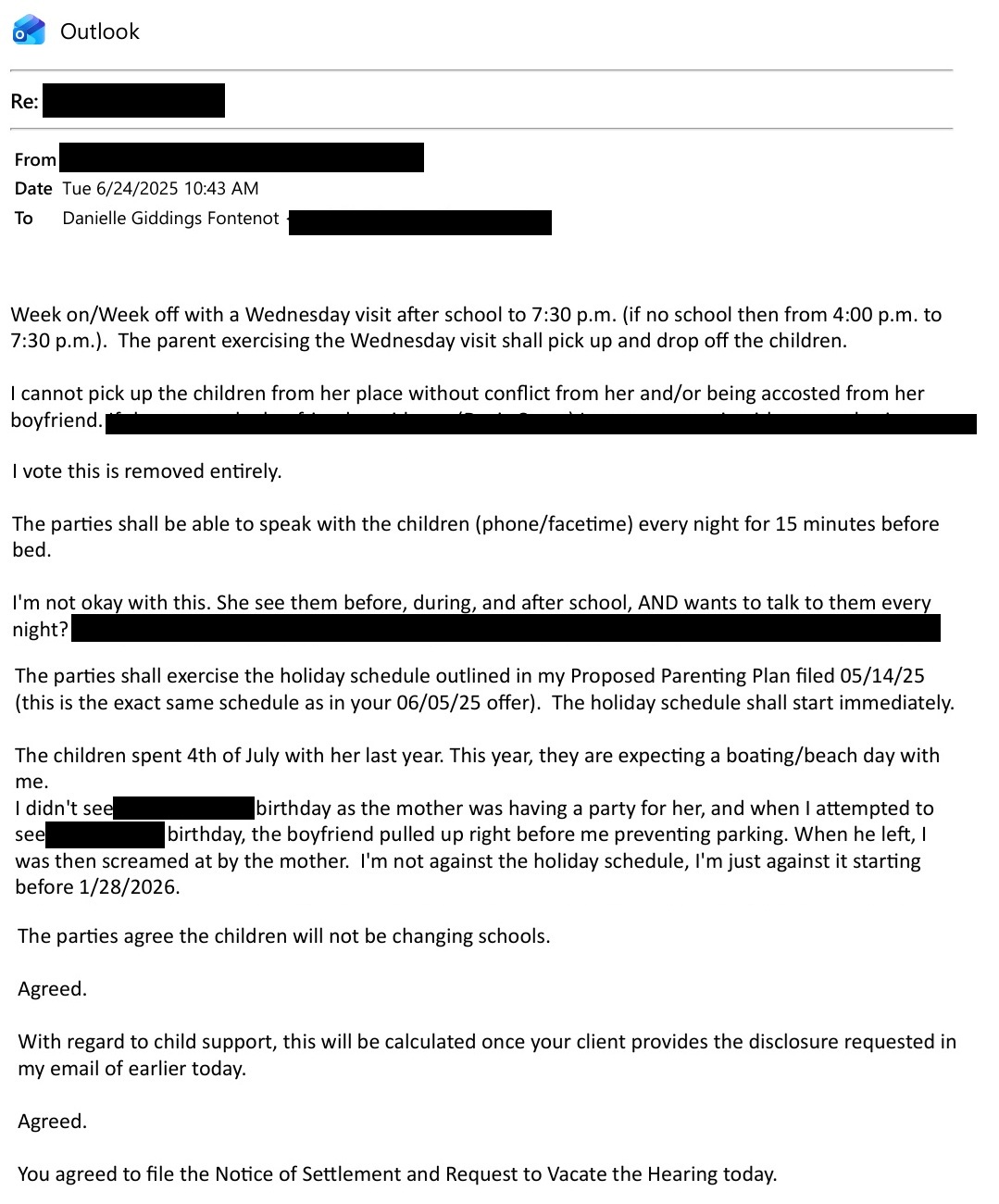
After reviewing the proposal, Father sent objections.
The purpose of this chapter is not to argue whether the objections were right or wrong. The point is that objections were made before the disputed text message was sent.
Readers may notice that Father's position regarding school choice changed. Father was willing to forgo a school change in exchange for alternating school events. That understanding was not reflected in a written agreement.
Chapter 4: The Dispute Deepens
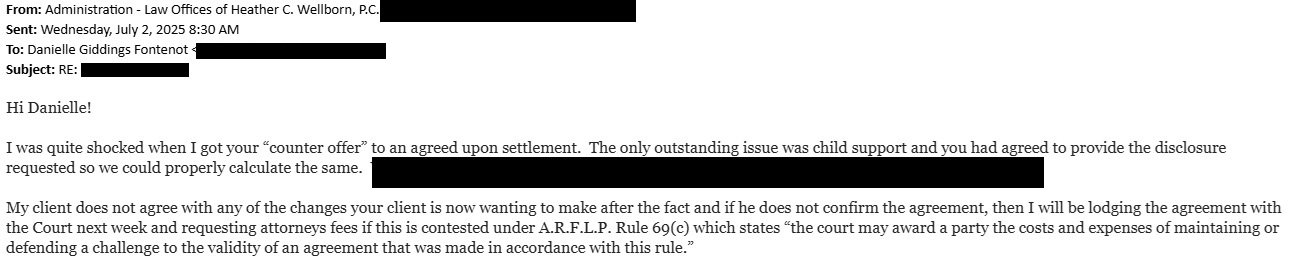
After receiving Father's objections, counsel forwarded them to opposing counsel as a counteroffer. Opposing counsel responded that an agreement had already been reached and rejected further changes.
Shortly afterward, Father terminated the representation and proceeded without counsel.
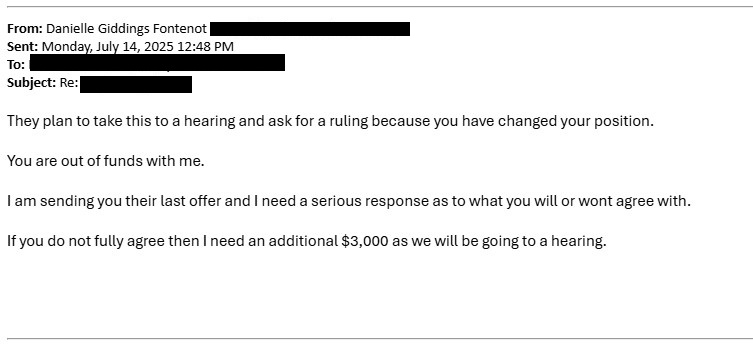



Chapter 5: The Enforcement Motion
After counsel withdrew, Mother filed a motion asking the court to adopt her proposed parenting plan as a binding Rule 69 agreement.
The motion relied heavily on the text: “He has little comments about pickups with boyfriend but he agrees.”
It was through this motion that Father first discovered the text message and first learned that the attorneys had been communicating by text.
Father disputed the motion and maintained that he had not agreed to the proposal.
Chapter 6: The Judgment
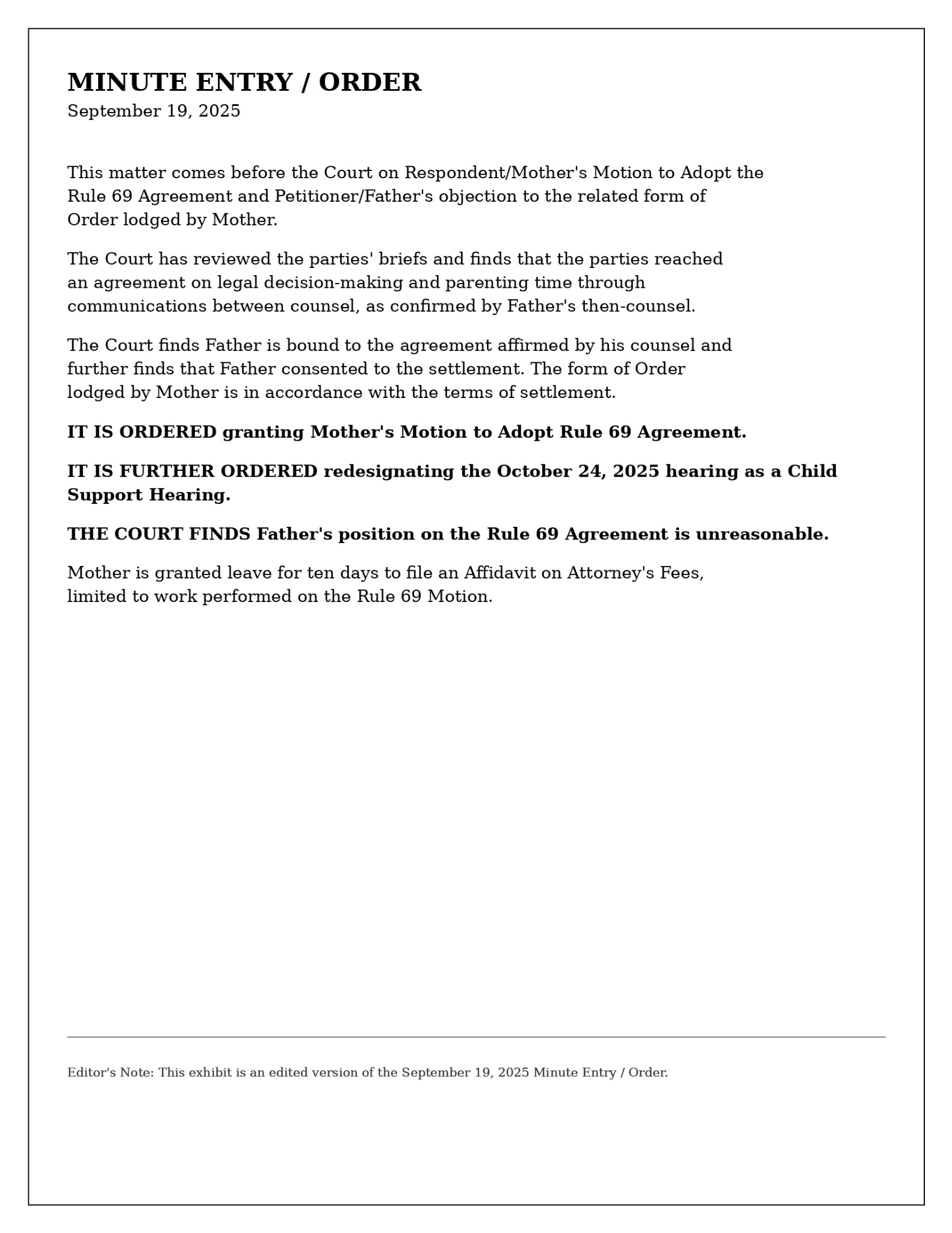
On September 19, 2025, the court granted Mother's motion and adopted the alleged Rule 69 agreement.
The court found that the parties had reached an agreement through communications between counsel and that Father was bound by the agreement affirmed by his attorney.
The court authorized Mother to seek attorney fees related to the Rule 69 dispute.
Chapter 7: What Is Rule 69?
Rule 69 allows parents to resolve family-law disputes through agreements rather than trial.
Once a court determines that a Rule 69 agreement exists, the agreement is presumed valid and the burden shifts to the party challenging it to prove a defect.
The September 19, 2025 ruling found that a Rule 69 agreement existed. That finding changed the case.
Chapter 8: Questions I Thought Would Matter
After the September 19, 2025 order, Father challenged the Rule 69 judgment in several different ways.
At the center of each challenge was a simple question: how did a proposal Father rejected become a binding court order?
Question: I never agreed to the proposal.
The court's answer: “Rule 69 allows agreements to be binding if signed by counsel, which is what occurred here.”
Question: But I objected to the proposal before the text message was sent.
The court's answer: Father's objections and counteroffer “do not negate his prior act of agreeing through his counsel.”
Question: What exactly did “he agrees” mean?
The text message never identified any proposal, any specific terms, or any particular agreement.
The court's answer: “In text and email, Petitioner's counsel stated that Petitioner agreed to those terms.”
Question: If an agreement already existed, why was a counteroffer sent afterward?
The court's answer: Father's objections and counteroffer “do not negate his prior act of agreeing through his counsel.”
Question: What authority did counsel have to make these decisions?
The court's answer: “Rule 69 allows agreements to be binding if signed by counsel, which is what occurred here.”
Question: Why wasn't there a hearing?
The court's answer: “There is no factual dispute, only a dispute as to the legal effect of those statements.”
As a result, no witness testified regarding the meaning of the text message, no cross-examination occurred regarding what was discussed, and the court decided the issue from the written record.
Question: Why did challenging the alleged agreement result in nearly $19,000 being awarded to Mother?
The court concluded that Mother had been defending a valid Rule 69 agreement since June 24, 2025. Because Father challenged the alleged agreement, the court entered a judgment against Father for $18,943.41 to cover Mother's legal fees.
Those were the court's answers. Whether those answers were correct remains pending on appeal.
Chapter 9: The Missing Messages
The text message became one of the most important pieces of evidence in the case.
After learning of it, Father requested communications concerning the alleged agreement.
Emails were produced. The text-message conversation was not.
As a result, only a single screenshot remains available for review, containing: “He has little comments about pickups with boyfriend but he agrees.”
The court concluded that this communication reflected a binding Rule 69 agreement.
The full context of the text-message conversation is unknown to Father.
Chapter 10: Why This Matters
Before this case, I assumed the greatest risk in hiring an attorney was receiving bad legal advice. I was wrong.
The risk I never considered was not knowing what was being said about me privately to the other side.
When I hired counsel, I believed I was hiring someone to communicate my position.
I did not realize that years later I would be reading a text message describing my concerns as “little comments” while that same communication was being used to support a parenting order I had opposed.
The result was the loss of parenting time, the loss of holiday time, reduced involvement in the children’s school, nearly $19,000 awarded to Mother, and years of litigation attempting to challenge or modify the outcome.
The purpose of this website is not to tell readers what conclusion to reach. The documents are provided so readers can review the communications, filings, rulings, and timeline for themselves.
My purpose is much simpler: before hiring an attorney, understand not only what your attorney is saying to you, but what your attorney may be saying about you.
Because communications you never see may later be used to define your position, determine your rights, and affect your relationship with your children.
Whether the result in this case was legally correct remains pending on appeal. The consequences, however, are not disputed.
Chapter 11: The Fallout
The consequences of the September 19, 2025 ruling extended beyond the Rule 69 judgment itself.
Once the court determined that Father had agreed through counsel, many later questions effectively received the same answer.
If Father wanted different terms, he should not have agreed.
If Father wanted additional provisions, he should not have agreed.
If Father wanted different holiday language, he should not have agreed.
If Father wanted different parenting-time provisions, he should not have agreed.
That response would be entirely reasonable if Father had agreed to those terms.
Where were those additional terms discussed?
Where were they negotiated?
Where were they accepted?
The documents presented on this website allow readers to review the communications and answer those questions for themselves.
Father raised objections after receiving the proposal. The issue is not whether those objections were correct, but where those concerns were considered.
The court ultimately concluded that Father's objections and counteroffer did not negate his prior act of agreeing through counsel.
Many people assume that an unfavorable parenting order can simply be modified.
Modification asks whether circumstances have changed since entry of the order.
Father's challenge concerns the circumstances that existed before the order was entered.
Those are not the same issue.
Whether the court's answer was correct remains pending on appeal.
Rule 69 and the attorneys' private text exchange produced what Father viewed as a procedural trap, or Catch-22.
Accept the proposal, and be bound to terms he rejected.
Challenge the proposal, and risk being bound anyway, together with an attorney-fee judgment.
Readers may decide for themselves whether that outcome was fair.
Appendix: Rule 69 Help Bot
The following is satire. The characters below are fictional. The questions, however, are real.
To help answer any remaining questions, here is a simulated Question & Answer section based on the issues raised in this case.
Mother submitted a settlement proposal.
Father agreed to it.
“He has little comments about pickups with boyfriend but he agrees.”
The agreement came first.
Father already agreed.
Through counsel.
Parents make decisions regarding their children.
Father agreed.
Through counsel.
Through counsel.
Did you still have questions about the agreement Father agreed to?
But he did agree.
Through counsel.
When the children reach adulthood, the court will generally lose jurisdiction.
We're going through counsel.
It's a Rule 69 agreement.